
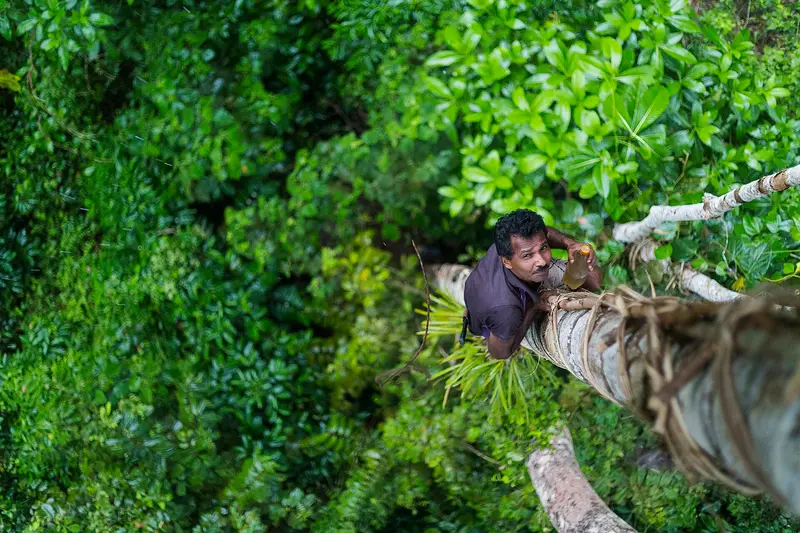
Kithul treacle is made by tapping sap from the flower stalk of the kithul palm (Caryota urens), then filtering it and boiling it over a wood fire for several hours, the same day, until it thickens into a dark syrup. Nothing is added.
The process in seven steps
- Find a flowering palm. Kithul grows wild in Sri Lanka's wet-zone forests and in village home gardens. Nobody plants it in rows, sprays it or feeds it fertiliser. Tapping starts when a mature palm produces its hanging flower stalks.
- Climb. The tapper climbs the palm, often 15 m (50 ft) or more, on a bamboo ladder lashed to the trunk.
- Prepare the flower stalk. Over several days the tapper prepares the stalk, traditionally wrapping it with vine, so that it will give sap.
- Tap. The stalk is cut and sap begins to drip into a pot hung beneath it.
- Collect twice a day. The tapper climbs back morning and evening to collect the sap and to shave a thin slice from the stalk so the sap keeps flowing.
- Boil the same day. Fresh sap starts to ferment within hours, so it goes straight to the hearth. There, traditionally in the hands of the women of the household, it is filtered and boiled for hours over a wood fire until it reaches the body of a treacle.
- Filter and seal. The treacle is filtered again and sealed in bottles while hot.
UNESCO's description of the craft records the same pattern: "The process entails climbing the tree using a ladder and wrapping the flower stalk with vine," and "traditionally, men collect the sap and women process it."
From treacle to jaggery, granules and flour
- Kithul jaggery (kithul hakuru) is treacle cooked further until it sets into soft, fudgy blocks.
- Kithul granules are jaggery dried and milled into a free-flowing sugar.
- Kithul flour (kithul piti) is different: it is a starch extracted from the pith of the trunk, made only from palms at the end of their tapping life.
Why genuine kithul is scarce
Kithul is seasonal and hand-made. Each palm gives a limited amount of sap, every litre has to be carried down by a tapper, and the work is hard and dangerous. Fewer young people are taking it up.
That scarcity is why adulteration is common. Researchers in Sri Lanka have documented treacle being stretched with cane sugar, which is hard to spot by eye. Rainwater getting into the sap has also been linked to the problem.
How Ecoroots checks every batch
We buy directly from tapping families in the villages around Sinharaja, with no collectors in between, so every batch can be traced to a village and a tapper. Each batch is checked for moisture and for cane-sugar adulteration before we accept it, and a certificate of analysis comes with every export lot. We also work with tappers on hygiene and on keeping rainwater out of the sap.
See our kithul range and specifications.
Questions
What is kithul treacle made from?
Only the sap of the kithul palm (Caryota urens), collected from its flower stalk and boiled down. Genuine kithul treacle has no added sugar.
How long does it take to make kithul treacle?
The sap is collected twice a day and boiled for several hours the same day it is tapped, because fresh sap ferments within hours.
Is the kithul palm cut down to make treacle?
No. Treacle and jaggery come from the sap of the flower stalks of living palms. Kithul flour is the exception: it is made from the trunk, and we make it only from palms at the end of their tapping life.
How can I tell if kithul treacle is genuine?
It is hard to tell by eye or taste, because cane sugar is the usual adulterant. Buy from a producer who traces each batch to its source and can provide a certificate of analysis that includes an adulteration check.
Sources

Bring genuine Sinharaja kithul to your market.
Tell us the product, pack format, volume and destination. We'll reply with a specification, availability and a quotation. Samples can be arranged for qualified buyers.