Kithul treacle, maple syrup and coconut sugar are all made by boiling down plant sap: kithul from the flower stalk of the Caryota urens palm in Sri Lanka, maple from the trunk of maple trees in North America, and coconut sugar from the flower buds of the coconut palm. Kithul has the darkest, smokiest flavour of the three. All three are still sugars.
The three at a glance
| Kithul treacle | Maple syrup | Coconut sugar | |
|---|---|---|---|
| Plant | Kithul palm (Caryota urens) | Maple trees, mainly sugar maple (Acer saccharum) | Coconut palm (Cocos nucifera) |
| Part tapped | Flower stalk | Trunk | Flower buds |
| Main origin | Sri Lanka | Canada and the north-eastern United States | South and South-East Asia |
| How it's made | Sap boiled over a wood fire for hours, the same day it is tapped | Sap boiled and evaporated until it thickens | Sap boiled until it crystallises, then ground |
| Form | Pourable syrup; also set as jaggery or milled into granules | Pourable syrup | Granulated sugar |
| Flavour | Dark caramel and toffee, gentle wood smoke, slightly mineral | Vanilla, caramel, woody | Light caramel, close to brown sugar |
| Published GI | 35 (one study, 10 people) | 54 | 54 (University of Sydney); 35 reported elsewhere |
Where each one comes from
Kithul treacle (kithul pani, sometimes sold as kithul honey) is made from the sap of the kithul palm, which grows wild in Sri Lanka's wet-zone forests and village home gardens. A tapper climbs the palm, prepares the hanging flower stalk and collects the sap that drips from it, usually twice a day. Because fresh sap ferments within hours, it is filtered and boiled the same day. The craft was inscribed by UNESCO on its list of the Intangible Cultural Heritage of Humanity in 2025.
Maple syrup is made from sap drawn from the trunks of maple trees in late winter and early spring, mostly in Canada and the north-eastern United States. The sap is boiled until most of its water has evaporated.
Coconut sugar comes from the sap of the coconut palm's flower buds. The sap is boiled until it thickens and crystallises, then broken up into granules. In Sri Lanka the same sap is also made into a coconut treacle.
Flavour and how to use them
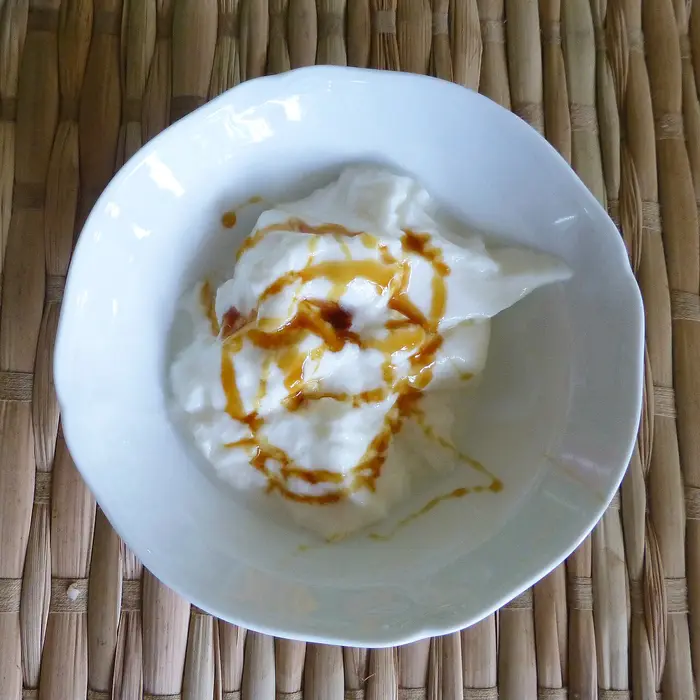
Kithul treacle is the most intense of the three: dark amber, glossy, with toffee and caramel notes and a light smoke from the wood fire. It is less cloying than cane syrup and more complex than maple. In Sri Lanka it is poured over buffalo curd, and it works anywhere you would use maple syrup or honey: pancakes, porridge, yoghurt, coffee, glazes and cocktails.
Maple syrup is lighter and more vanilla-like. Coconut sugar behaves like brown sugar in baking. If you want kithul in that form, kithul granules are milled kithul jaggery that measures and dissolves like brown sugar.
What the glycaemic index figures say
The glycaemic index (GI) ranks foods by how quickly they raise blood glucose compared with pure glucose. A GI of 55 or less is usually called low.
- Kithul treacle: a 2022 study in the Ceylon Medical Journal measured a GI of 35 in 10 healthy volunteers. It is a single, small study.
- Maple syrup: researchers at the University of Sydney's GI group cite a GI of 54 for pure maple syrup.
- Coconut sugar: the Sydney University Glycemic Index Research Service measured 54 for a popular brand. A lower figure of 35 has been reported by Philippine sources, which shows how much results can vary by product and method.
On these published figures, all three fall in the low-GI band, and kithul's one measurement is the lowest. That is not a health claim. Each is still a concentrated sugar, and GI says nothing about the total amount of sugar you eat.
Which one should you choose?
Choose on flavour and use. Kithul treacle is for people who want something distinctive, with a story behind it: a hand-made sweetener from one island, made by a craft that UNESCO recognises. Maple syrup is the familiar choice for North American and European breakfasts. Coconut sugar is the easy swap for brown sugar.
One caution with kithul: adulteration with cane sugar is a well-documented problem in Sri Lanka. Buy from a producer who can trace the treacle to its source and test each batch. Read how we do it.
Questions
Is kithul treacle the same as kithul honey?
Yes. Kithul treacle (kithul pani) is often sold as kithul honey, but it is made from palm sap, not by bees.
Can I use kithul treacle instead of maple syrup?
Yes. Use it in the same amounts over pancakes, porridge or yoghurt, in coffee, or in baking. Its flavour is darker and smokier than maple.
Does kithul treacle have a low glycaemic index?
A 2022 study in the Ceylon Medical Journal measured a GI of 35 for kithul treacle in 10 volunteers, which is in the low range. It is a single small study, and kithul treacle is still a sugar.
Is coconut sugar the same as kithul jaggery?
No. Coconut sugar comes from the coconut palm. Kithul jaggery (kithul hakuru) is made from the sap of the kithul palm, cooked until it sets into blocks.
Sources
- Weeraratne & Ekanayake (2022), Kithul (Caryota urens) treacle: a healthy natural sweetener?, Ceylon Medical Journal 67(1)
- University of Sydney GI group — Q&A with Jennie Brand-Miller (maple syrup GI 54)
- University of Sydney GI group — coconut sugar tested by SUGiRS (GI 54)
- UNESCO Intangible Cultural Heritage — Kithul Madeema/Kithul Kapeema (2025)
- A study on the practice of adulteration of kitul sap products in Sri Lanka, Sri Lanka Journal of Social Sciences
Bring genuine Sinharaja kithul to your market.
Tell us the product, pack format, volume and destination. We'll reply with a specification, availability and a quotation. Samples can be arranged for qualified buyers.